The topic
Chinese character classification
classifier
one output per character
→
one output per character
集
U+96C6
U+96C6
- Input: one glyph, already cut out of the page.
- Output: which character it is, among thousands of classes.
- The reading step of OCR, for scripts with no alphabet.
Why it is hard
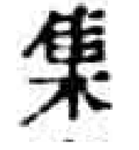
Same class, different looks:
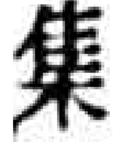 集
集Different classes, near-identical looks:
未 末 · 己 已 巳 · 呆 杏
Andfartoomanyclasses!
Family 1 · Predict
Write the tree, then look it up
森
→
CNN
→
attention decoder
→
⿱ 木 ⿰ 木 木
→
dictionary lookup
→
森
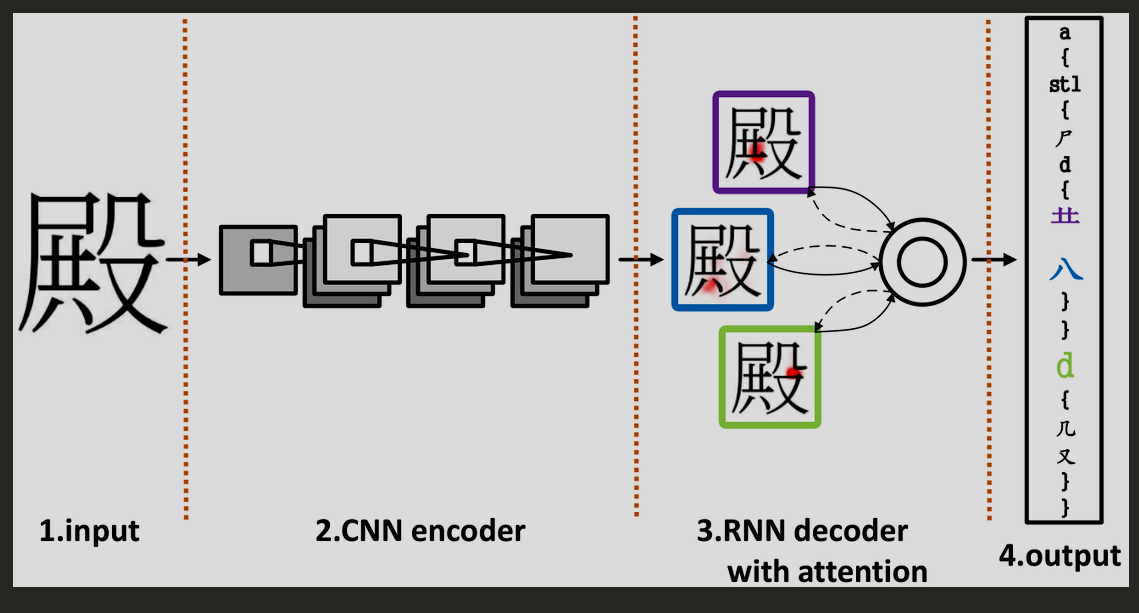
RAN / DenseRAN 2018 → RSST 2024 → CDC-RAN 2025
- Interpretable: one radical, one region.
- Errors pile up along the sequence; one wrong token, wrong character.
The decoder learns to write combinations it has seen.
Faced with a new character, it writes a familiar one.
And without the tree?
Match the image to a printed font
image encoder
→
similarity
←
same encoder
←
集
one font renderingper candidate class
OpenCCD CVPR 2022 → PCSS 2024
- Same CLIP idea, but the "caption" is a picture of the character in a font, not its tree.
- Works where no tree exists: Japanese kana never seen in training, rare variants.
Needs a font that draws every class. Fewer than 5 fonts cover all 97k
characters, and a modern font is not the shape of a 17th-century woodblock.
On the next chart it is drawn dashed: each unseen class comes with a printed glyph the tree methods never see, so it is not a like-for-like comparison.
Where my work fits
A learned embedding, used to fix a reader's mistakes
- I train a contrastive glyph encoder, family 3's recipe on the image side.
- Each glyph's nearest neighbours vote on its label: a graph over the whole book.
What the graph is for
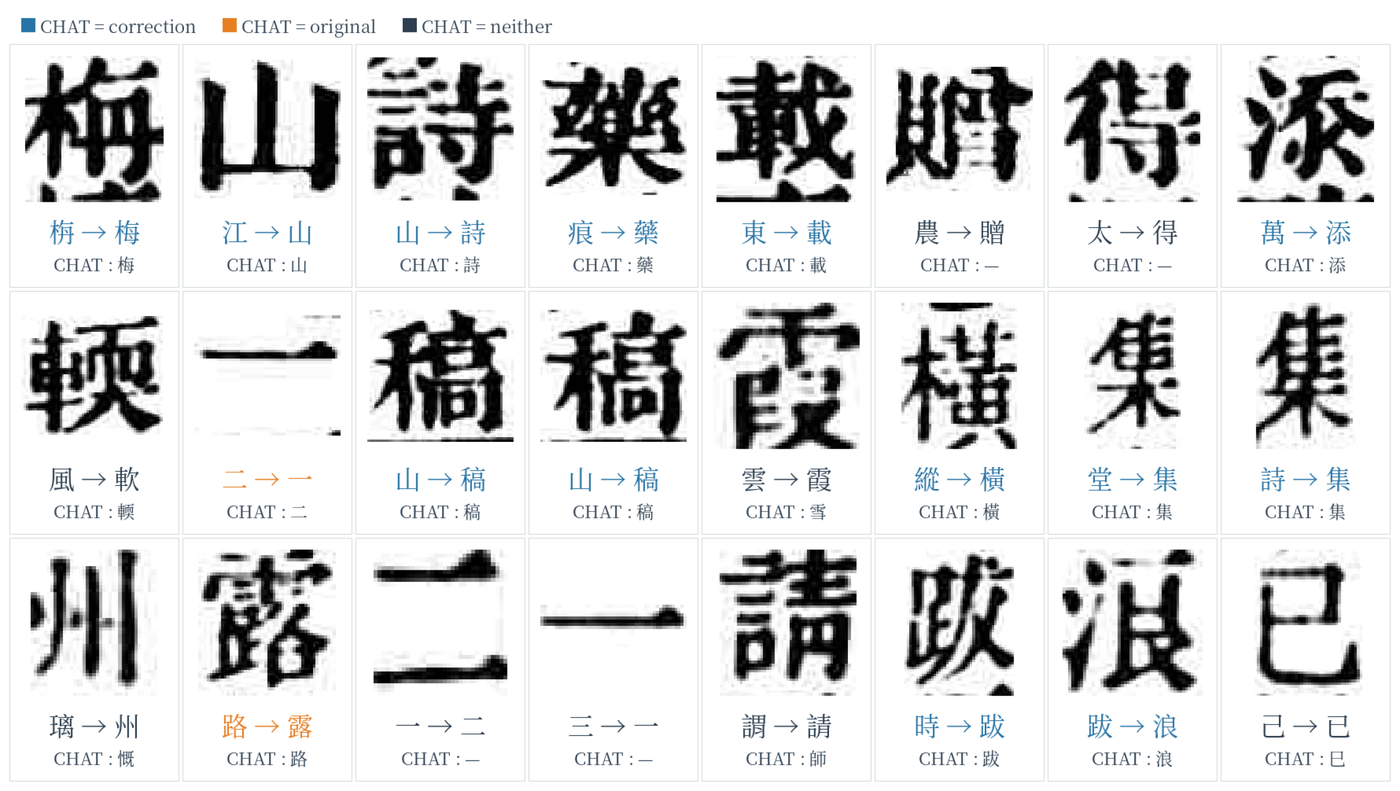
- Detect errors: a glyph whose reading disagrees with its look-alikes.
- Catch hallucinations: the reader writes a plausible character that is not on the page.
- Expose model conventions: one reader writes the Taiwan form, another the Hong Kong form, of the same glyph.
Run on a real Qing-dynasty volume: 770 pages, no ground truth.